
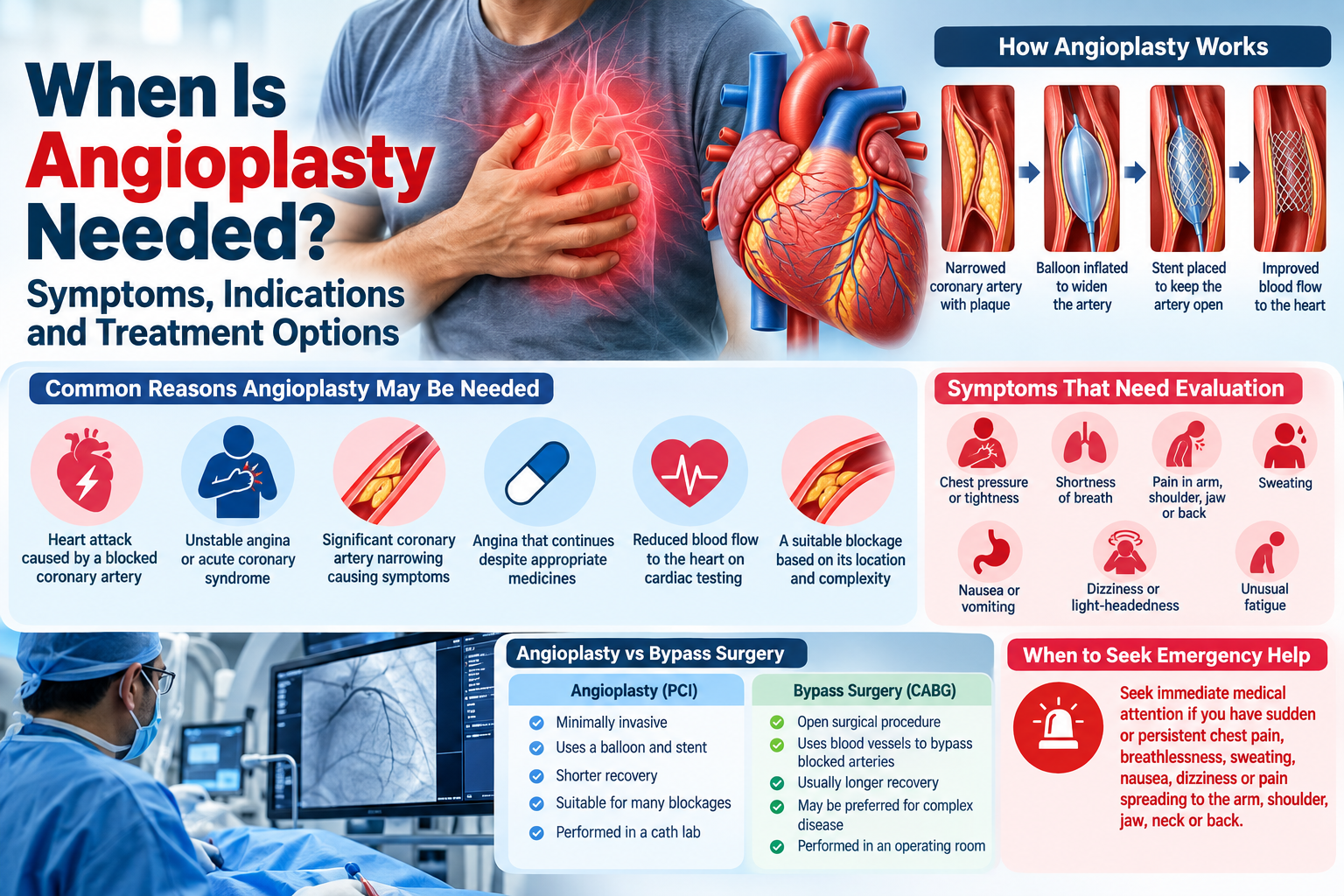
Angioplasty is a minimally invasive procedure used to improve blood flow through narrowed or blocked coronary arteries. It is commonly performed when fatty deposits, blood clots or other blockages reduce the supply of oxygen-rich blood to the heart muscle. During coronary angioplasty, a catheter is guided into the affected artery, usually with a small balloon used to widen the narrowed area. A stent is often placed to help keep the artery open.
If you have been diagnosed with coronary artery disease or have been advised to undergo angioplasty, you may wonder, “When is angioplasty needed?” The answer depends on several factors, including your symptoms, the severity and location of the blockage, whether you are having a heart attack, how well your symptoms respond to medicines, and your overall heart health.
Angioplasty is not automatically required for every person with a blocked or narrowed artery. A cardiologist evaluates the individual situation and considers medicines, lifestyle changes, angioplasty, stenting, or bypass surgery depending on the patient’s condition.
What Is Angioplasty?
Coronary angioplasty, also called percutaneous coronary intervention (PCI), is a procedure used to open a narrowed or blocked coronary artery.
The coronary arteries supply blood and oxygen to the heart muscle. Over time, plaque made up of cholesterol, fats and other substances can build up inside these arteries. This process, known as atherosclerosis, can narrow the arteries and reduce blood flow.
During angioplasty, a thin catheter is inserted through a blood vessel and guided toward the affected coronary artery. A small balloon at the tip of the catheter is inflated at the narrowed area to improve the opening. In most modern procedures, a stent is then placed to help maintain blood flow through the artery.
When Is Angioplasty Needed?
There is no single blockage percentage or symptom that automatically means angioplasty is necessary. The decision depends on the patient’s clinical condition and coronary anatomy.
Angioplasty may be considered in situations such as:
- A heart attack caused by a blocked coronary artery
- Unstable angina or acute coronary syndrome
- Significant coronary artery narrowing causing troublesome symptoms
- Angina that continues despite appropriate medicines
- Reduced blood flow to the heart demonstrated by cardiac testing
- A coronary blockage that is suitable for PCI based on its location and complexity
For stable coronary artery disease, treatment decisions are individualised. Some patients can manage their symptoms effectively with medication and lifestyle changes, while others may benefit from revascularisation. The choice between PCI, bypass surgery and medical treatment depends on factors such as symptoms, anatomy, disease complexity and overall health.
1. Angioplasty During a Heart Attack
One of the most important situations in which angioplasty may be needed is an acute heart attack.
A heart attack occurs when blood flow through a coronary artery is suddenly reduced or blocked, depriving part of the heart muscle of oxygen. In an appropriate patient, urgent PCI can reopen the affected artery and restore blood flow.
For certain heart attacks, particularly STEMI, primary PCI is an important emergency treatment when it can be performed promptly by an appropriate medical team.
Symptoms of a heart attack can include:
- Chest pressure, tightness or discomfort
- Pain or discomfort in the arm or shoulder
- Pain spreading to the jaw, neck or back
- Shortness of breath
- Sweating
- Nausea or vomiting
- Light-headedness
- Unusual weakness or fatigue
Women may also experience symptoms such as upper-back pressure, nausea, shortness of breath and unusual tiredness.
If these symptoms occur suddenly, seek emergency medical attention rather than waiting for them to disappear.
2. Angioplasty for Unstable Angina
Another important indication is unstable angina.
Unlike stable angina, which commonly occurs with physical activity and improves with rest, unstable angina may occur unexpectedly, including during rest. It can indicate a significant reduction in blood flow to the heart and may progress to a heart attack.
Depending on the results of the clinical assessment, ECG, blood tests and coronary angiography, treatment may include medicines, angioplasty with stenting, or coronary artery bypass surgery.
New, worsening or persistent chest discomfort should be treated as a medical emergency.
3. Angina That Does Not Improve With Medicines
People with stable angina are often initially treated with medicines and lifestyle changes. Medicines may include drugs that reduce the heart’s workload, improve blood flow, control cholesterol or reduce the risk of blood clots.
If angina continues despite appropriate medical treatment, a cardiologist may consider revascularisation, which can include angioplasty or bypass surgery depending on the coronary anatomy.
The purpose may be to improve blood flow and reduce symptoms that are limiting everyday activities. Angioplasty can decrease angina and improve the ability to perform physical activity when symptoms are caused by a suitable coronary blockage.
4. Significant Narrowing of a Coronary Artery
A coronary artery may become significantly narrowed because of plaque buildup. If the narrowing is affecting blood flow and is responsible for symptoms or evidence of myocardial ischaemia, angioplasty may be considered.
However, the decision is not based only on the percentage of narrowing seen on an angiogram. Doctors also consider:
- Location of the blockage
- Length and complexity of the lesion
- Number of affected arteries
- Symptoms
- Results of other heart tests
- Heart pumping function
- Presence of diabetes or kidney disease
- Previous heart procedures
- Overall surgical and procedural risk
For complex coronary artery disease, a Heart Team may be involved in deciding whether PCI, bypass surgery or another treatment strategy is appropriate.
5. Evidence of Reduced Blood Flow to the Heart
Some people may have coronary artery narrowing without obvious chest pain. Doctors may identify reduced blood flow through tests such as a stress test or other cardiac imaging.
When test results indicate that a coronary blockage is clinically important, the cardiologist may discuss treatment options. Depending on the findings, treatment could include medication and lifestyle changes, angioplasty, or bypass surgery.
The goal is not simply to treat an image showing a blockage but to determine whether opening that artery is likely to benefit the patient.
Symptoms That May Indicate a Need for Cardiac Evaluation
Not every person who experiences chest discomfort needs angioplasty. However, symptoms suggestive of reduced blood flow to the heart should be evaluated.
Possible symptoms include:
| Symptom | What it may indicate |
| Chest pressure or tightness | Possible angina or another cardiac condition |
| Breathlessness | May occur with reduced cardiac blood flow |
| Pain spreading to arm or shoulder | Possible cardiac symptom |
| Jaw, neck or back discomfort | Can occur with angina or heart attack |
| Sweating | May accompany acute coronary syndrome |
| Nausea or vomiting | Can occur during a heart attack |
| Dizziness or light-headedness | May occur with cardiac problems |
| Unusual fatigue | Can accompany heart disease, particularly in some women |
These symptoms do not automatically mean that angioplasty is required. They indicate the need for appropriate medical evaluation.
How Do Doctors Decide Whether Angioplasty Is Needed?
Before recommending angioplasty, a cardiologist considers your symptoms, medical history, test results and coronary anatomy.
The evaluation may include:
Electrocardiogram
An ECG records the electrical activity of the heart and can help identify signs of a heart attack or other cardiac problems.
Blood Tests
Blood tests, including cardiac troponin testing when appropriate, can help identify heart muscle injury.
Echocardiogram
An echocardiogram uses ultrasound to assess the structure and pumping function of the heart.
Stress Testing
In selected patients, stress testing can help determine whether physical exertion is associated with reduced blood flow to the heart.
Coronary Angiography
Coronary angiography uses contrast dye and X-ray imaging to visualise the coronary arteries and identify narrowed or blocked areas. It can help doctors determine whether a blockage is suitable for PCI or whether another treatment approach is more appropriate.
Current chest-pain guidance emphasises structured risk assessment and appropriate cardiac testing rather than relying on symptoms alone.
Angioplasty vs Bypass Surgery
Angioplasty and coronary artery bypass grafting (CABG) are both methods of improving blood flow to the heart, but they work differently.
| Angioplasty | Bypass Surgery |
| Minimally invasive catheter-based procedure | Open surgical procedure |
| Usually uses a balloon and stent | Uses blood vessels to create a new route around blocked arteries |
| Generally involves a shorter recovery | Usually involves a longer recovery |
| Suitable for many types of coronary blockages | May be preferred for certain complex or extensive disease |
| Performed in a cardiac catheterisation laboratory | Performed in an operating room |
The choice between PCI and CABG depends on the patient’s coronary anatomy, disease complexity, symptoms, overall health and other factors. Some patients may benefit more from bypass surgery than angioplasty.
What Happens During Angioplasty?
Angioplasty is performed in a cardiac catheterisation laboratory.
A typical procedure involves:
- Preparing the patient and administering local anaesthesia.
- Inserting a thin catheter through a blood vessel, commonly in the wrist or sometimes the groin.
- Guiding the catheter to the coronary artery.
- Injecting contrast dye to identify the blockage.
- Positioning a small balloon at the narrowed area.
- Inflating the balloon to widen the artery.
- Placing a stent when appropriate.
- Confirming improved blood flow before completing the procedure.
The exact technique varies depending on the patient’s anatomy and clinical situation.
What Happens After Angioplasty?
After angioplasty, patients are monitored for a period of time. Some people may go home the same day or after a short hospital stay, while those treated during a heart attack or with other medical concerns may need longer hospitalisation.
Medicines are particularly important after stent placement. Depending on the type of stent and the patient’s circumstances, doctors commonly prescribe antiplatelet medicines to reduce the risk of blood clots forming inside the stent.
Patients should take prescribed medicines exactly as directed and should not stop antiplatelet medication without speaking with their cardiologist.
Cardiac rehabilitation, regular physical activity when medically appropriate, a heart-healthy diet, smoking cessation and control of blood pressure, cholesterol and diabetes are also important parts of long-term heart care.
Can Angioplasty Be Avoided?
In some patients, yes. Angioplasty is not necessary for every person with coronary artery disease.
Depending on the patient’s condition, treatment may involve:
- Heart-healthy lifestyle changes
- Cholesterol-lowering medicines
- Blood pressure treatment
- Antiplatelet medicines
- Anti-anginal medicines
- Diabetes management
- Smoking cessation
- Regular medical monitoring
For stable angina, medicines and lifestyle measures can often help control symptoms. If symptoms remain troublesome or the clinical situation changes, revascularisation may then be considered.
What Are the Risks of Angioplasty?
Angioplasty is commonly performed, but like any medical procedure, it carries potential risks.
These can include:
- Bleeding or bruising at the catheter insertion site
- Damage to a blood vessel
- Allergic reaction to contrast dye
- Abnormal heart rhythm
- Blood clot formation
- Re-narrowing of the treated artery
- Heart attack or stroke
- Kidney-related complications in susceptible patients
The individual risk depends on factors such as age, kidney function, overall health, the urgency of the procedure and the complexity of the coronary disease.
Your cardiologist should explain the expected benefits, risks and alternatives before a planned procedure.
When Should You Seek Emergency Medical Help?
Do not wait for a routine appointment if you develop sudden or persistent chest discomfort, particularly if it is accompanied by shortness of breath, sweating, nausea, dizziness or pain spreading to the arm, shoulder, jaw, neck or back.
Acute chest pain requires prompt medical assessment because it can be caused by a heart attack or another life-threatening condition.
Frequently Asked Questions About Angioplasty
When is angioplasty needed?
Angioplasty may be needed when a coronary artery is significantly narrowed or blocked and restoring blood flow is clinically appropriate. It is commonly used during certain heart attacks and may also be considered for unstable angina or persistent symptoms caused by suitable coronary artery disease.
Is angioplasty required for every blockage?
No. The presence of a blockage does not automatically mean that angioplasty is necessary. Doctors consider symptoms, blood-flow impairment, coronary anatomy, disease complexity and overall health before recommending treatment.
Is angioplasty the same as stent placement?
Not exactly. Angioplasty uses a balloon to widen a narrowed artery, while a stent is a small mesh tube placed inside the artery to help keep it open. In modern coronary PCI, angioplasty and stenting are commonly performed together.
How long does angioplasty take?
The procedure can vary in duration depending on the number and complexity of blockages and whether it is being performed as an emergency. Some procedures may take around 30 minutes, while more complex cases can take longer.
Can a person live normally after angioplasty?
Many people return to normal activities after recovery, but angioplasty does not remove the underlying tendency to develop coronary artery disease. Long-term medicines, follow-up care and heart-healthy lifestyle changes remain important.
Conclusion
Understanding when angioplasty is needed can help patients make informed decisions about their heart health. Angioplasty may be used to restore blood flow when a coronary artery is significantly narrowed or blocked, particularly during certain heart attacks and in selected patients with angina or other forms of coronary artery disease.
However, angioplasty is not automatically required for every blockage. A cardiologist considers the patient’s symptoms, test results, coronary anatomy, disease complexity and overall health before recommending PCI, medication, bypass surgery or another treatment approach.
If you experience sudden or persistent chest pressure, breathlessness, sweating, nausea, dizziness or pain spreading to the arm, shoulder, jaw, neck or back, seek emergency medical attention immediately. Early assessment and appropriate treatment can be critical when acute coronary syndrome or a heart attack is suspected.
Medical Disclaimer: This article is intended for general educational purposes only and should not replace professional medical advice, diagnosis or treatment. The decision to undergo angioplasty should be made after evaluation by a qualified cardiologist based on the individual patient’s clinical condition and test results.
Contact Details:
Kolekar Hospital & ICCU
| Multispeciality Hospital in Chembur |
Address: 2nd Floor, Omprakash Arcade, Approach to Ambedkar Garden Bus Stop Chembur Gaothan, Chembur 2nd & 3rd floor Omprakash Arcade, at Ambedkar garden, Chembur, Mumbai, Maharashtra 400071
Phone: 02235083100
Website: kolekarhospital.com